
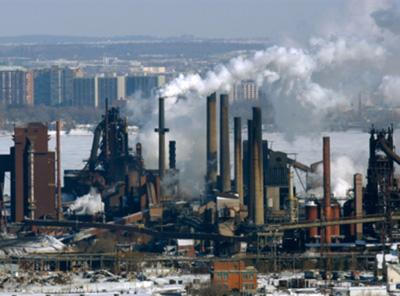
What I remember most about Hamilton was the smell that greeted visitors as they motored along the QEW (Queen Elizabeth Way) and over the old Skyway bridge toward Hamilton. A pungent, suffocating odor emanated from the huge smoke stacks that dominated the skyline, shrouding the bay area in a greenish/yellow cloud. Enormous slag piles lined the shores.
My godmother and her husband owned a bakery that serviced the men of steel and their families. We rarely visited them and when we did, I’d hold my nose as we passed by the industrial sector of the city. That is where the worst stench seemed to congregate.
This was Steeltown, a town that for a century was dominated by two giant steel companies – Stelco and Dofasco.
While the name will no doubt stick, the city itself has changed. Healthcare and related industries are becoming the largest employment sectors in the city, bringing with them new high-tech buildings and a changing workforce.
Meanwhile Stelco was bought by U.S. Steele in 2007 and endured layoffs and ultimately stopped producing steel in 2011. At the end of last year, U.S. Steele separated the Canadian arm from its parent, repatriating the name Stelco for the Canadian steel operation. They are currently in negotiations with a new buyer.
Dofasco had a different journey. In 2007 it became a subsidiary of the world wide steel conglomerate ArcelorMittal. Today ArcelorMittal Dofasco in Hamilton is viewed as a technology driven advanced manufacturing company, of which steel production using an automated oxygen steelmaking furnace is only part of what they do. The slag piles still occupy the shoreline of the bay. They are sold to LaFarge Canada Inc. who crush the slag into pellets and sell it to customers for making cement or for use as an aggregate.
***
Charli Mills’ March 2nd Carrot Ranch Flash Fiction Challenge was to include slag in our 99 word (no more, no less) story. As always, she suggests we go where the prompt leads us.
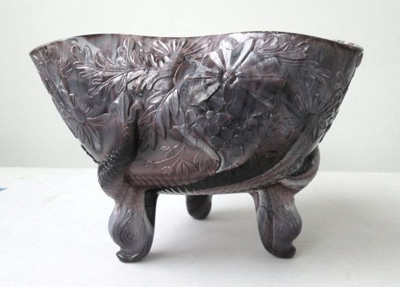
The prompt immediately reminded me of Steeltown since I used to live in the Golden Horseshoe region of Southern Ontario. However, while doing research, I discovered that a century ago, some iron mills in England ground their silicate slag by-product into a powder and sold it to glass manufacturers. These companies used it as part of their pressed glass processing, resulting in an opaque glass of various colours with white or cream streaks. It was also known as ‘Marble glass’ or ‘Malachite glass’. Manufactures made kitchen ware, decorative vases, bowls and figurines out of it. George Davidson produced items in North East England in the 1890’s through the early years of the 20th century along with other glassworks companies like Sowerby and Greeners. Any of their items that still exist today are considered collectors’ pieces. I found this photo of a lovely rare Sowerby bowl with diving dolphins as its legs. This became the inspiration for my story. And at the request of my Hubby, Jim and Gladys have returned.
The Heirloom
Jim wiped droplets of sweat from his forehead. He and Gladys were spending their Saturday cleaning out the attic and reminiscing over silly items they’d found in boxes.
“Looky here Jim. It’s my great-grandmother’s Diving Dolphins bowl,” said Gladys holding up a purple dish. “I remember my Granny loved it. She always had gumdrops in it.”
Jim reached for the artefact. “Wonder how much it’s worth.”
“Looks like a rare piece of slag glass to me. I’d like to keep it. I’m thinking that some ol’ things are worth keeping around.”
“Like me?”
“Just like you, you ol’ goon.”
 Eloquently Kate
Where I live in upstate New York was once one of the premier shoe manufacturing areas of the country. A nearby community was called “The Magic City”. I wonder how we could use shoes to return to our once-prosperity. Enjoyed reading about that slag!
LikeLiked by 1 person
I like the name, “Magic City”; hopefully it will come alive again some day. I’m glad you enjoyed the post. Thank you. 🙂
LikeLike
So interesting to read about Hamilton, the smell and the shoreline of slag. Now you have me wondering if my pieces of slag might have come from discarded Malachite glass dishes in the old homestead. In a way, it returned to an earlier state! I’m glad to see Jim and Gladys revised, too.
LikeLiked by 1 person
I have to thank you Charli. Your prompt sent me on an extensive research journey. It brought back a glimpse in my memory bank of high school where I remember seeing pictures from the Hamilton mills as part of the class where we were talking about steel production. Piecing together what happened to the two steel giants in Southern Ontario via newspaper clippings was fascinating. Then I got absorbed in the antique market of collectibles in slag glass. Wow…. it was quite engrossing. Thanks Charli. 🙂
LikeLiked by 1 person
Ah, such are the pleasant symptoms of Research for Writing, a disorder that can result in producing historical fiction. 😀 I’m delighted you had an outlet for all you discovered!
LikeLiked by 1 person
Charming! I come from a revitalized old Steel Town myself. 🙂
LikeLiked by 2 people
So glad you dropped by Kerry. I’m glad you enjoyed the post and that your old Steel Town has also been revitalized. 🙂
LikeLiked by 2 people
I really enjoyed your post, Kate, with it introduction to history and then its relevance to your story. It is such a cute story. I agree with Sarah – those gumdrops are a lovely touch, and it has a really sweet ending. Aw … 🙂
LikeLiked by 3 people
Thanks Norah. I’m glad you liked the post and the ‘feel good’ story. 🙂
LikeLiked by 2 people
Interesting history. I’ve never heard the term “Malachite glass”. What a gorgeous bowl! Great flash, too. Love the little details (gumdrops) and that ending. Aw… ❤
LikeLiked by 4 people
I loved how slag, a discarded waste product was transformed into something so gorgeous as the diving dolphin bowl, now treasured and worth keeping. I felt it was time for a sweet story to make people smile and the candy bowl just called for one. Thanks Sarah! 🙂
LikeLiked by 2 people